Windows are essential for any building, providing enjoyment for people who work in day-lit environments with a view to the outside. So why does a highly glazed building often have the blinds lowered while the sun is shining?
Direct sunlight can be beneficial, particularly in cold climates where windows can bring desired passive solar gains to warm a building during the day. Floor-to-ceiling glass curtain walls, however, are not a good thing in almost any climate, no matter how much glamour they may add to the perception of a “five-star” building. Here’s why.
Greenhouses in the Sky
Glass allows most of the incidental heat (and light) from the sun to be transmitted indoors. Heat is then trapped inside as it converts from short wave to long wave. The long wave heat cannot pass through the glazing, creating a “greenhouse effect” and the need for more air conditioning.
Solar control coating of glass was developed to deal with glass buildings. A coating of tinted glass either absorbs or reflects non-visible heat. Even with superior thermal performance and solar protection, however, tinted glass conducts considerable heat compared to an insulated wall.
For example, heat entering the east and west façades of an office building in Singapore can admit 750 watts per square metre, which is equivalent to leaving an electric heater running three to four hours daily for each two-square metre section of the façade.
A study in India found that energy consumption is proportional to glazed area. For each 10 percent increase in glazed area, energy consumption for an office in a sub-tropical city like Delhi increases by 15 percent for clear glass and by 2-4 percent for solar control glazing. When the glazed area exceeds 20 percent, the office can get overheated even in winter when daytime temperatures can dip to 130C, requiring some cooling for comfort.
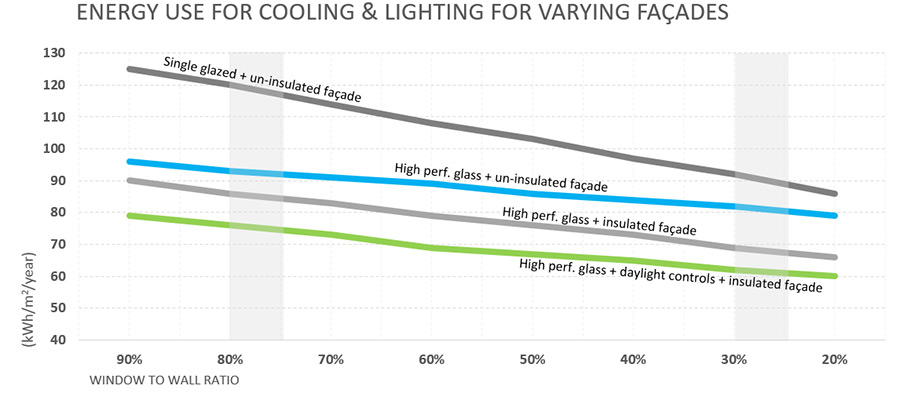
The linear relationship between WWR and energy consumption for the lighting and cooling of an office building in Manila in the Philippines as simulated using the EDGE App.
Blinded by the Light
What about the benefits of natural daylight? Doesn’t glazing let light in and therefore save energy? Not unless electric lights are either switched off or dimmed. Most employees rarely make the conscious effort to turn off lights when there is daylight, and seldom have access to a switch that will turn off the lights in a brighter area without annoying their co-workers elsewhere.
The truth is that almost 60% of window areas are covered by blinds at any given time. The presence (or absence) of blinds has no correlation to the orientation of the façade or time of day.
Blinds prevent glare and stop some heat gain to the inside, but are not very effective. Once solar radiation comes through the glazing, most of the heat is absorbed by the blinds and then radiated inside. With blinds down, any visual advantage or energy savings are lost.
In climates like Mumbai, the inner surface of window glass can reach 430C, causing “radiant discomfort.” This effect acts asymmetrically on the occupant, causing parts of the body to be considerably cooler or warmer. It’s the same sensation as sitting next to a fireplace when the temperature in the room is within the comfort range. This is another cause of internal blinds coming down often.
High First Costs
If a glazed building increases operational cost, is glass an efficient material for construction? Developers, financiers and building managers often don’t grasp the impact of glazing on capital cost, which is more expensive compared to bricks or concrete blocks. Double-glazed, solar-control glazing costs approximately $150 per square metre, which is 30 percent higher compared to typical walling materials (~$100/m2).
Since more glazing almost always means bigger air-conditioning capacity, it adds more capital cost – not just for the glass but also for the installation of larger chillers, ducts and fans. Less glazing can save on energy bills by 22 percent while highly glazed buildings can add $25-44 per square metre in capital costs, according to an analysis using the EDGE online application.
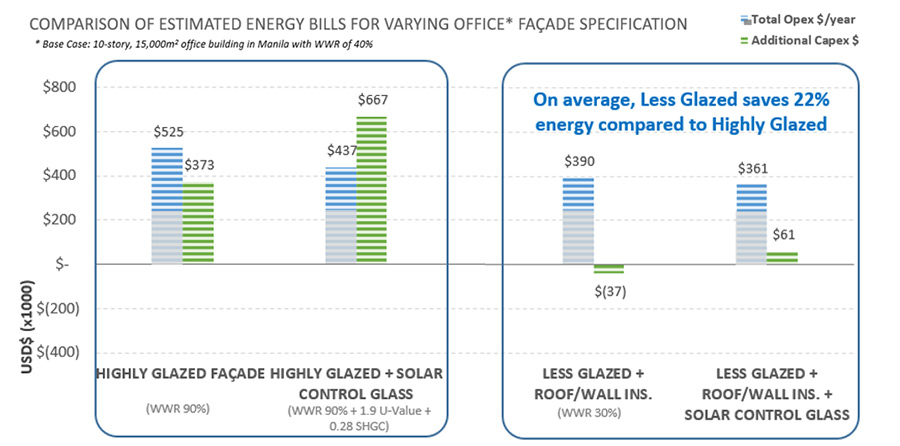
A quick comparison check of façade options using the EDGE App reveals that less glass leads to energy savings and reduced capital costs.
Commodified Aesthetics
In the last few decades, architectural language has given more emphasis to “lightness” and “transparency,” with a push towards fully glazed envelopes. A high proportion of glass is a desirable corporate image for tall, high-end offices around the world.
Co-star, a U.S. and UK-based company that rates commercial properties, gives five stars to buildings with aesthetics that include “full height glass, corner windows, abundant natural daylighting” and “a high ration of glazed to opaque exterior walls.” If your building has “punched or ribbon windows” it receives three stars. These ratings reinforce the bias towards glass-covered buildings, a trend which has spread to emerging markets.
Lloyd Alter argues that glass architecture has allowed architects to become lazy as curtain wall suppliers end up designing the exterior of the building to look pretty in an architectural rendering.
Seven Sensible Design Concepts for Highly Glazed Façades
While it is clearly better to have less glazing (<20-30 percent WWR), if a highly glazed façade is unavoidable, there are a few ways to maximize benefits and minimize costs for both builders and occupants:
- Perform daylight simulations during the design phase to ensure uniform distribution of daylight as deep as possible into the building’s interior. A glass façade can generate high glare and a contrast between lux levels indoors, which is undesirable.
- Install photo-electric sensors along the perimeter to dim artificial lighting when daylighting is available. If you are going to pay the “tax” on glass through higher utilities, get the best value by switching off or dimming artificial light.
- Cut back on glazing on east and west façades by varying the ratio for effective compromise. Rather than 80 percent WWR on all four façades, keep 80 percent on the northern and southern exposures with 10-20 percent on the eastern and western façades, where there is a greater risk of glare and direct solar gains.
- Eliminate glazing below desk level as inclusion in the bottom 1-1.5 metres of the façade contributes little to overall daylighting. In order to provide privacy for workers, this area could be made either opaque or translucent. A better option would be to rethink the façade and consider an insulated wall to improve thermal performance.
- Install exterior shading with horizontal overhangs on the northern and/or southern façades and an egg-crate combination of horizontal and vertical overhangs on the other orientations. This ensures daylight and views while providing a permanent solution to solar heat gains. Movable (operable) exterior shading in particular provides greater occupant control.
- Reset internal blinds so they don’t sabotage the daylighting strategy. To make sure blinds aren’t left permanently down make sure someone is routinely bringing them up. A more designed solution is to automate blinds with a motorized common switch.
- Explore innovative composite sandwich glazing products with phase change material (e.g., Glass-X) or transparent insulation blinds integrated inside the glazing system.
Looking towards the future, it’s possible to imagine a world where we no longer drool over shiny façades. Through a conscious effort to be more practical, innovative and smart, a five-star office building can emerge where the blinds are up, daylight is ample, and workers are both comfortable and productive. Rethinking our notion of glamour will be dependent upon all of us: architects, developers, financiers, corporates and employees.
“Reflections on a Shiny Facade” originally appeared in Eco-Business and has been published with permission.